
“One more for the road!” This modern idiom refers to someone having one last drink of alcohol before leaving a place, usually a bar or pub, to either head home or on a journey of some kind. But where did the saying come from? The roots of the phrase can be traced back to British drinking culture in the seventeenth and eighteenth centuries. A decorated delftware punch bowl found at the waterfront of Brunswick Town/Fort Anderson State Historic Site in Brunswick County, NC (and now being conserved at the QAR Lab) provides added context to the origins of this cheeky expression.
Punch bowls are associated with the European ritual of punch drinking. Punch, or rum punch, was an alcoholic cocktail made from rum or brandy as a base, with sugar, citrus fruit, spices (usually grated nutmeg), and water added to complete the drink. As Britain’s imperial possessions expanded globally, and these ingredients were regularly imported, punch became a popular drink throughout Europe and the North American colonies. In 1737, Benjamin Franklin authored a poem published in Poor Richard’s Almanac that describes making the beverage:
Boy, bring a Bowl of China here,
Fill it with Water cool and clear:
Decanter with Jamaica ripe,
And Spoon of Silver clean and bright,
Sugar twice-fin’d in pieces cut,
Knife, Sieve and Glass, in order put,
Bring forth the fragrant Fruit, and then
We’re happy till the Clock strikes Ten.
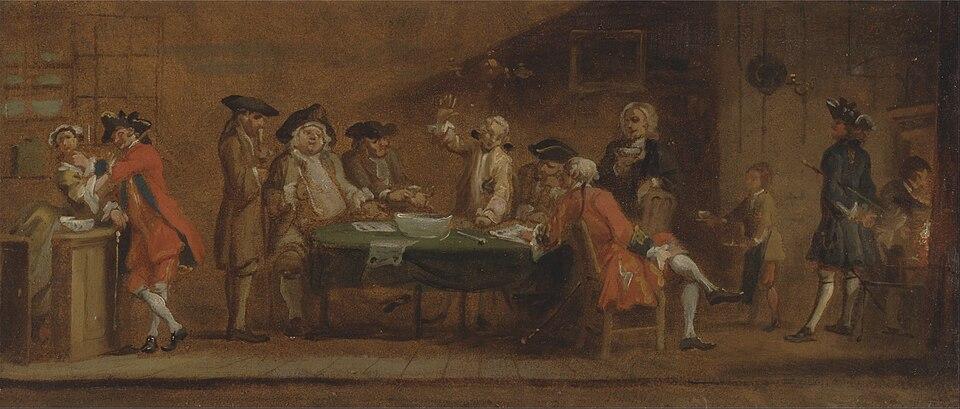
Punch was prepared and served in bowls of varying sizes that were centrally placed in social gatherings (Antczak 2021:564). The contents were ladled from the communal punch bowl into glass stemware or tumblers. Both men and women drank punch domestically or in public establishments like punch-houses, pubs, taverns, and coffee-houses. Most households had their own punch bowls that the homeowner brought out during important events or meetings. Gatherings around the punch bowl were lively occasions where the usually steadfast social norms of etiquette were relaxed (Harvey 2008:209). The communal act of punch drinking reinforced feelings of hospitality among drinkers, which were cemented by rousing toasts to the host, the king, other party guests, and to prosperity or health (Breen 2012:81). Despite widely circulated warnings of overindulgent binge-drinking that spread throughout early eighteenth-century British society, punch remained a staple elixir for all classes of people into the early nineteenth century. As Georgian dining traditions evolved, the purchase of finely decorated punch bowls became expressions of social status among the wealthy in places like Brunswick Town, where individuals hosted important guests and travelers at their personal estates or places of business.
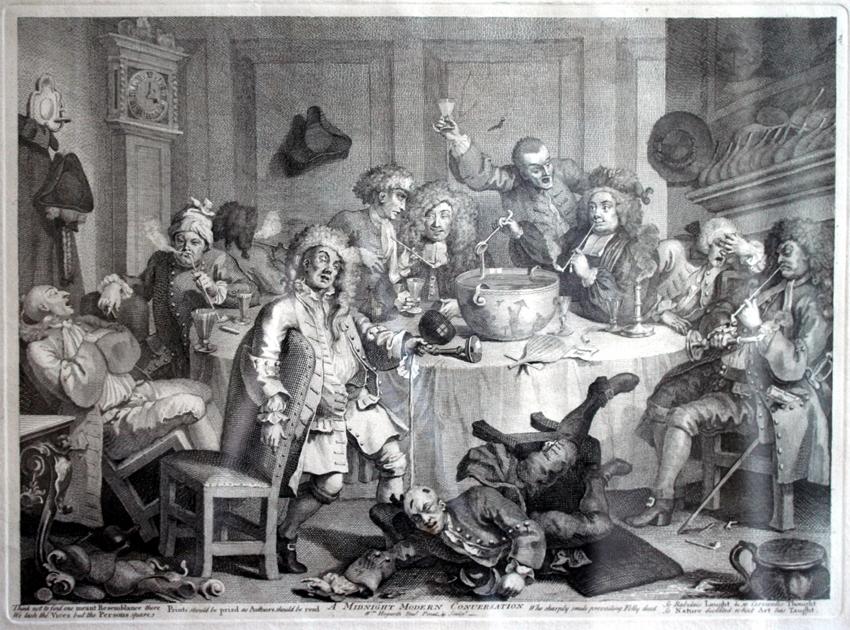
Decorated punch bowls commonly appear in the archaeological record on North American sites in both urban and domestic contexts (Breen 2012:89-90). Since these objects occupied a conspicuous place in these settings, fine workmanship went into their production. Early materials used to manufacture punch bowls included glass, pewter, silver, and wood. By the late seventeenth century and throughout the eighteenth century, the most common punch bowl was ceramic. Ceramic punch bowls could be made from English delftware, creamware, pearlware, porcelain, various stoneware, or fine Chinese export porcelain.
Often, the exterior of the ceramic punch bowl was vibrantly hand-painted to display exotic Chinese-porcelain-inspired themes and landscapes, stylized foliage, geometric designs, animals, and other motifs. Inscriptions were also painted on the interior of the bowl, which became visible once the punch was gone and the bowl empty. These written inscriptions might include names or locations, pithy instructions like “Drink Fair / Don’t Swear” or “Pass it Round,” and invitations to toast like, “Success to Trade” or “Success to British Arms” (Antczak 2021:565).
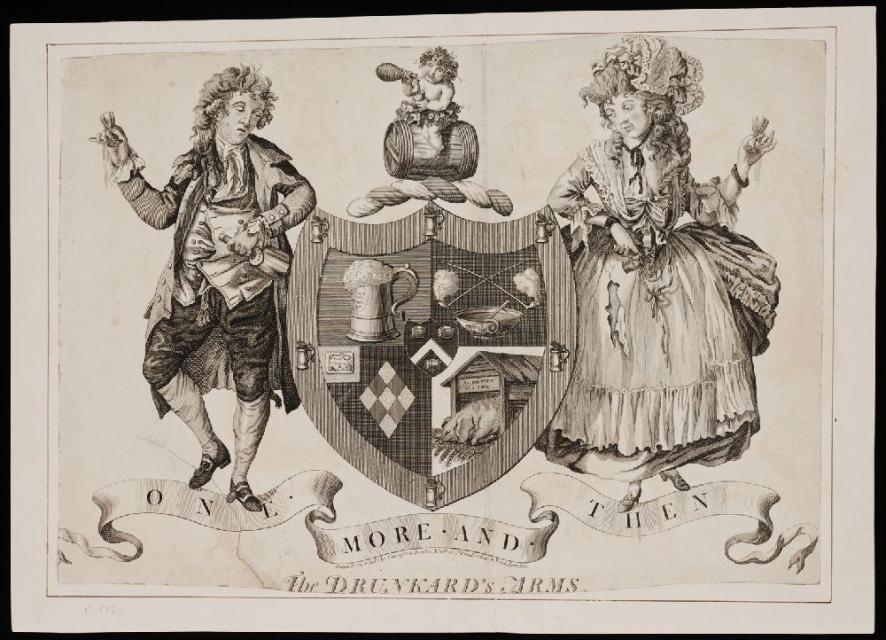
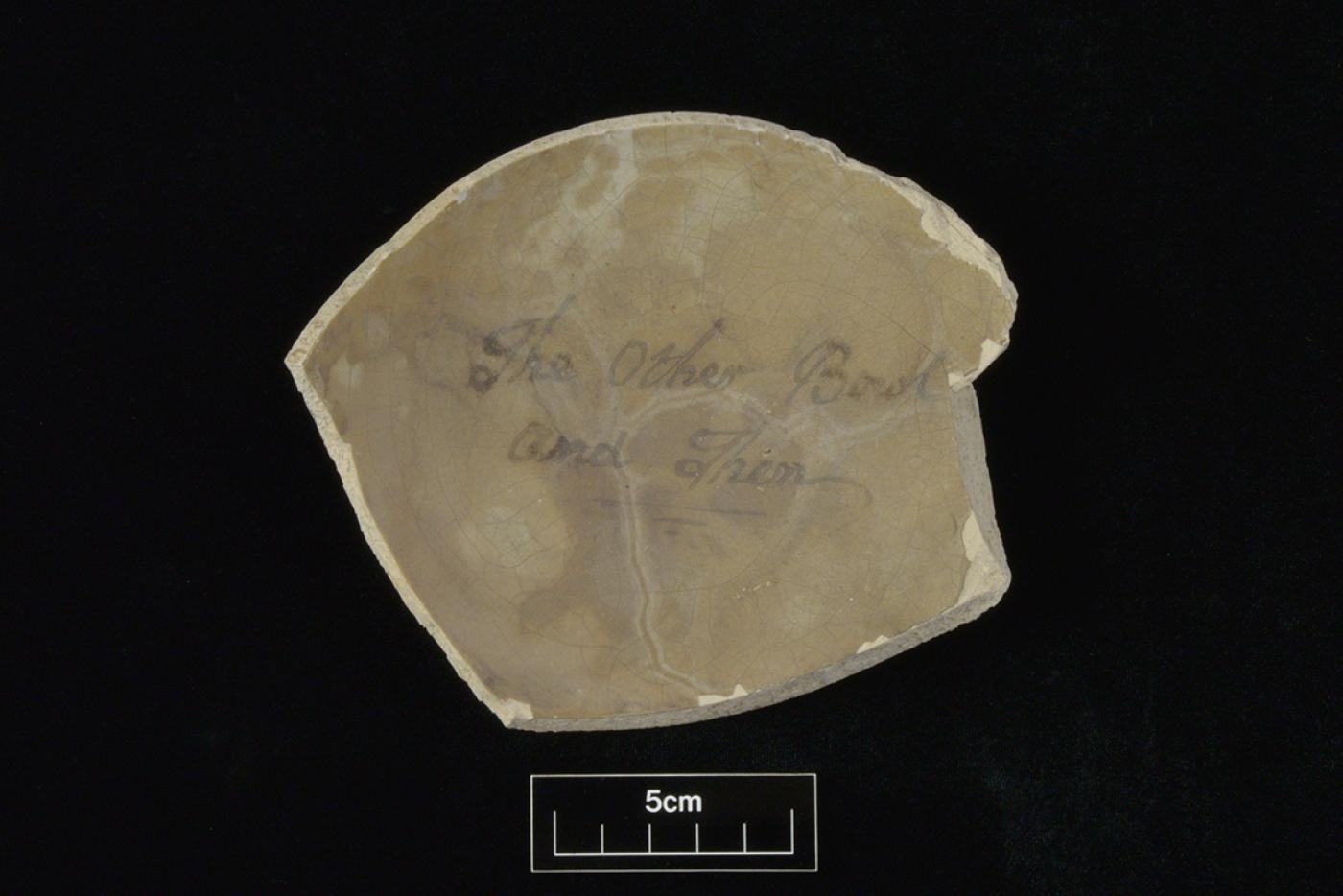
The delftware punch bowl found at Brunswick Town is part of this tradition. The outside of the bowl displays a tropical landscape design, while the inside is decorated at its center with the hand-painted phrase, “The Other Bowl and Then.” This call to conviviality is a shortened variant of the eighteenth-century saying, “One bowl of punch more, and then we part” – the historical precursor of “One more for the road!” Variations of this saying on similar delftware bowls include, “One More and Then,” “One More Bowl Will,” or “One Bowl More.” The inscription later appeared as the motto below a satirical coat of arms entitled, "The Drunkard's Arms," issued as a print in the late-eighteenth century. Expressions like this were an amusing reflection on the increasing role that colonial punch drinking held in the realms of gentility, sociability, and hospitality in the second half of the eighteenth century (Breen 2012:81).
Artifacts like this punch bowl allow us to explore the past with greater appreciation of events recorded in historical narratives. Travelers along the King’s Highway passing through Brunswick Town and sailors aboard ships anchoring in the port were likely served punch in bowls like this at one of the many taverns or ordinaries within the coastal town. On the eve of revolution in 1773, Josiah Quincy recounted evenings spent at the homes of Cornelius Harnett Jr. and William Dry III, two influential figures at Port Brunswick. Quincy later referred to Harnett as “the Samuel Adams of North Carolina” for his resistance to British authority, while other contemporary travelers noted that Dry, “talks treason by the hour” (Andrews 1921:145; Coquillette and York 2007:241). One can imagine these early North Carolina patriots gathered around the punch bowl, commiserating on the state of colonial affairs, and planning the revolutionary acts that would eventually lead to American independence.
Drink up me hearties, yo ho!
Images:
-Interior view of the decorated delftware punch bowl found in the fill of a colonial wharf at Brunswick Town. Image by NC Department of Natural and Cultural Resources.
-Painting by Joseph Highmore circa 1725 titled, “Figures in a Tavern or Coffee House” that depicts the centrality of the punch bowl in social settings. Public Domain.
-The ironically titled “A Midnight Modern Conversation” by William Hogarth in 1733 showing a group of men in various stages of drunkenness around the decorated punch bowl. Public Domain.
-Satirical engraving of “The Drunkard’s Arms” by London publisher Carington Bowles in 1785 with the popular phrase “One More and Then” displayed on the banner. Public Domain. Courtesy of The Lewis Walpole Library, Yale University.


References:
-Andrews, Evangeline W. (editor). 1921. Journal of a Lady of Quality: Being the narrative of a journey from Scotland to the West Indies, North Carolina, and Portugal in the years 1774 to 1776. Yale University Press, New Haven, CT.
-Antczak, Konrad A. 2021. “Punch bowls and punch paraphernalia.” In, The Oxford Companion to Spirits and Cocktails, David Wondrick and Noah Rothbaum, editors, pp. 564-565. Oxford University Press: Oxford.
-Breen, Eleanor. 2012. “One More Bowl and Then?” A material culture analysis of punch bowls. Journal of Middle Atlantic Archaeology 28:81-97.
-Coquillette, Daniel R. and Neil L. York (editors). 2007. Portrait of a Patriot: The Major Political and Legal Papers of Josiah Quincy Junior, Vol. 3: The Southern Journal (1773). The Colonial Society of Massachusetts, Boston, MA.
-Harvey, Karen. 2008. Barbarity in a Teacup? Punch Domesticity and Gender in the Eighteenth Century. Journal of Design History 21(3):205-221.
Jeremy Borrelli is the Staff Archaeologist with the Program in Maritime Studies in the Department of History at East Carolina University. Jeremy previously worked as a graduate assistant and field technician for the Queen Anne's Revenge Shipwreck Project. His current research interests include the Brunswick Town waterfront and the Spanish privateer La Fortuna, which wrecked at Brunswick Town in 1748. Notably, Jeremy was part of the team to discover several shipwrecks at the Colonial-era port city in 2024 and 2025.