
Spring 2006 Conservation and Documentation Report
QAR Field Operations – May 2006
Artifact Conservation & Documentation
Sarah Watkins-Kenney – QAR Project Chief Conservator. 05/04/06
I. Personnel:
The QAR Conservation & Documentation (C&D) team (from QAR Lab in Greenville) will be on site for each day of the operation. The QAR Lab will be closed for the two weeks of the field operations.
II. Timetable (X = on site):
05-05-06 – SWK & WMW will take C&D supplies to Morehead for loading onto R/V Shellpoint at Coastguards dock, to set up C&D stations on boat and on dockside.
C&D Team:
Sarah Watkins-Kenney (SWK)- QAR Project Chief Conservator
Wendy Welsh (WMW) - QAR Lab Manager, Archaeologist/Conservator
Kim Smith (KMS) - QAR Conservation Technician
Linda Carnes McNaughton (LCMN) -Volunteer , Historian/Conservation assistant
Valerie Grussing (VG) - QAR Conservation Technician
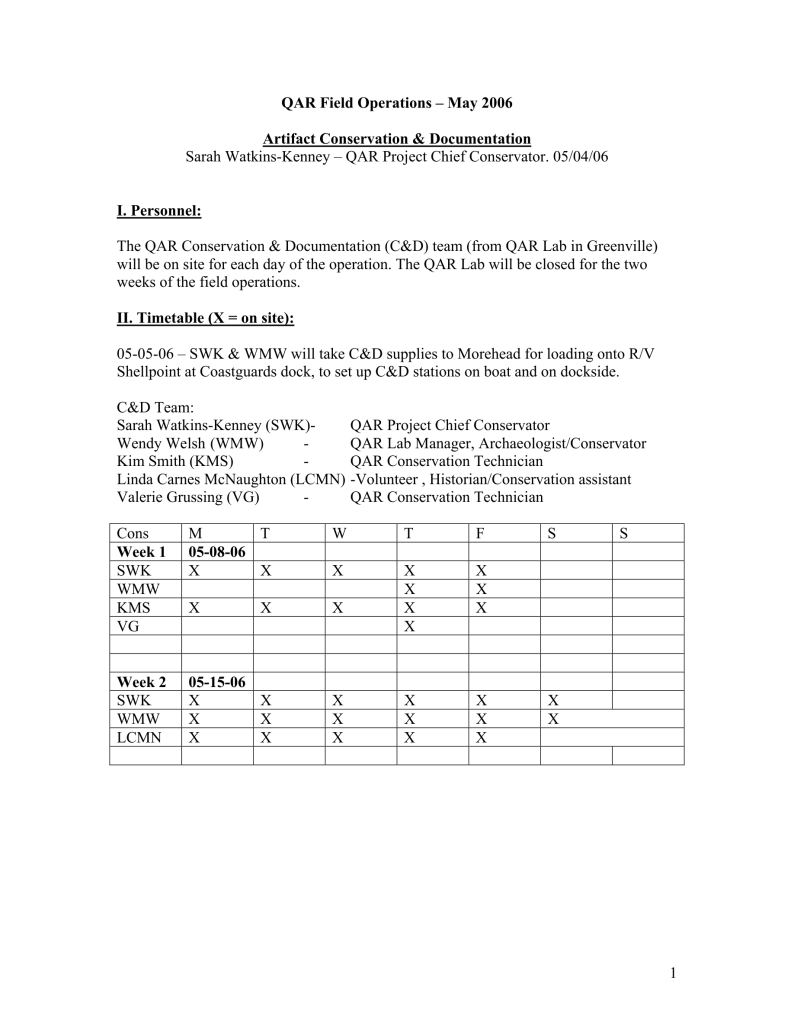
| Cons | M | T | W | T | F | S | S |
|---|---|---|---|---|---|---|---|
| Week 1 | 05-08-06 | ||||||
| SWK | Yes | Yes | Yes | Yes | Yes | No | No |
| WMW | No | No | No | Yes | Yes | No | No |
| KMS | Yes | Yes | Yes | Yes | Yes | No | No |
| VG | No | No | No | Yes | No | No | No |
| Week 2 | 05-15-06 | ||||||
| SWK | Yes | Yes | Yes | Yes | Yes | Yes | No |
| WMW | Yes | Yes | Yes | Yes | Yes | Yes | No |
| LCMN | Yes | Yes | Yes | Yes | Yes | No | No |
III. Documentation ON SITE includes:
i TAGS-
- Mylar or Tyvek are available from C&D team.
- Must be tied to all artifact/concretions with cable ties so that tag lies on top surface as in situ. Provenance E & N taken to tag.
- Marked in pencil (both types of tag can be written on with pencil underwater).
- Information that must be on each tag before end of each day: E, N provenance, diver initials, date recovered, QAR#, C&D team initials.
- For ballast, dredge/sieve material – tag should be place inside bag or tied to container as appropriate.
ii BAG & CONTAINER LABELS -
- Each bag should be marked on outside, in permanent marker, with E&N provenance, QAR#.
- Each container should have duck tape label on outside listing QAR# of contents.
iii. ARTIFACT INVENTORY LIST
- Record of QAR.000# assigned – as assigned.
- No. of containers per QAR.000#
- Deposition (shore, transferred to QAR lab)
iv C&D – ARTIFACT FIELD LOG -
- Main field record of: QAR# sequentially assigned – also includes E,N provenance, Diver initials, basic object information, conservator initials etc.
- To be completed by C&D team as work done.
v C&D – DAILY LOG (NOTES) -
- To record daily – general C&D activity notes as well as additional comments on artifacts (noting QAR#) as needed.
vi ARTIFACT LAB SHEETS
- Record basic dimensions and sketch drawing for each artifact recovered as appropriate
- Record any conservation steps taken.
- Record deposition – location and dates of artifacts as moved from ship to shore to QAR lab.
vii CONSERVATION DATABASE
- Records to be entered on master artifact database held at QAR Lab in Greenville after artifacts transferred. At site C&D laptop will have latest version of artifact database for reference.
IV. Conservation and Documentation – Numbering:
The following applies to all artifacts studied & recorded in situ and those for which recovery –i.e. removal from site is deemed to be the most appropriate step. Such artifacts are likely to be those deemed to be diagnostic, fragile or otherwise `in danger’ (see QAR Field Operations Spring 2005 – Chris Southerly). For consistency one of the C&D team (WMW or SWK) will be responsible for assigning QAR# s and for maintaining inventory of artifacts transferred from boat to shore and then shore to QAR lab.
i. In situ:
- Artifacts/ concretions being recorded in situ may be assigned a general number (e.g. Cannon – C1 etc; Anchors- A1 etc; Hoops - H1 etc).
- They may also be assigned a Field/QAR # whilst in situ if it is planned that they will be recovered in 2005. Conservation will assign the next sequential QAR# as appropriate when requested by diver/archaeologist.
- The concretion/artifact will be tagged in situ with a MYLAR or TYVEK tag, with General #, QAR# and provenance (E, N),and or unit #, and diver initials, date written in pencil. Tag to be tied to artifact/concretion with cable ties or line so that tag lies on top surface of object.
ii. Dredge/sieving:
- Retrieving and documenting artifacts recovered from dredge/sieving responsibility of C&D team.
- Diver/archaeologist must let C&D team know provenance (E &N) of area being dredged before start and when changed.
- Each dredge area will be assigned a QAR.000#. Artifacts will be assigned sequential sub numbers (e.g. QAR601.001; 601.002; 601.003) once transferred to the QAR lab. If artifacts from same dredge area are separated, e.g. by material type for storage and transport, at site, each group will have the same QAR.000#. WMW will be responsible for maintaining record of number of containers per QAR# and their deposition.
- TAGS – each artifact or group of artifacts to have a TYVEK tag with: Provenance (E, N); QAR#; date; conservator intials; diver initials – written in pencil.
iii. Ballast Stones:
- Diver/archaeologist must tag ballast or groups of ballast with TYVEK or MYLAR tag - with provenance (E, N), diver initials, and date in pencil, before passing ballast over for processing.
- Each group of ballast from a particular 5x5 ft excavation unit will be assigned a QAR.000#.
- Individual ballast stones will not normally be given an individual QAR#. If they are it will be assigned a sequential sub numbers by C&D team (WMW) (e.g. QAR601.001; 601.002; 601.003).
V. Artifacts and concretions recovery – Diver/archaeologist responsibility:
- Recovery of artifacts (bringing them to the surface) is the responsibility of diver/archaeologist although conservators may advise on methods of lifting objects, to minimize any damage, as needed.
- Artifacts should be recovered from site in lift containers of appropriate size, material and strength for the item being recovered. C&D team will provide a range of options.
- Before passing object to C&D team each Diver/archaeologist is responsible for assigning provenance of artifact/s; attaching MYLAR or TYVEK tag to each concretion or artifact – with cable ties, or line.
- Tag to be tied so that lies on top surface (as in situ) of artifact/concretion.
- Information on tag in pencil to include: - E, N provenance, diver initials, date recovered.
VI Artifacts and concretions processing – C&D team responsibility:
C&D team responsible for:
- Documentation – including assigning field/QAR #, and logging all information including provenance in Artifact Field log.
- First Aid Conservation Treatment.
- Wet storage of finds.
- Transfer of finds – a. from boat to shore storage at end of each day and
b. from shore storage to QAR Conservation Lab in Greenville at the end of the week. - Keeping a Daily Log of conservation activities during field operation
On receiving the artifact sequence of actions likely to be:
i. Preliminary Documentation – at dive platform:
- Place object in seawater in a container – keep object wet at all times.
- Assign Field/QAR # - taking next sequential # from QAR database/or list of #s if db not available.
- Mark tag with artifact Field/QAR#). Container must be marked with object’s number also.
- Enter artifact information in C&D Artifact Field log.
- Inform diver/archaeologist of artifact field/QAR#
- Start Lab sheet.
- Enter information in C&D Daily Log.
ii. First Aid Conservation – at dive platform:
- All artifacts (except ballast stones) to be kept wet at all times.
- Place artifact in seawater, in container appropriate to size and fragility of the object. E.g. plastic bag, plastic ex-food container, plastic bucket. If too large for container keep artifact wet by wrapping with wet cloth or foam and sealing in plastic sheeting or tarp.
- As far as practical keep metals, organics, and in-organics (ceramics, glass, bone) in separate overall container.
- As far as possible avoid any cleaning of artifacts. Any cleaning should be limited to gentle rinsing to remove loose sand or other non-artifact debris.
- Containers to be kept covered, and as cool as possible – e.g. not in direct sun if possible.
iii. Secondary Documentation: at dive platform or at shore storage area (see D).
- Digital photo of artifact (with scale and field# in frame) – both sides as appropriate.
- Complete C&D Artifact Field Log.
- Record the following information on the lab sheet in pencil:
- Field/QAR #
- Recovery date
- Recovered by
- Provenience
- Identity –dimensions: max. length, width, thickness, diameter,(in 1/10 inches), wet weight (g).
- Colour
- Material Type
- Count
- Basic description
- Sketch with dimensions or 1:1 scale drawing/sketch on the reverse of sheet as appropriate.
- Description
Although more accurate, detailed information will be recorded once the artifact is at the QAR Conservation Lab. It is critical to record as much of the above as soon as possible on site, as a means of identifying the artifact in case it becomes separated from its labels.
iv. Transfer of Artifacts from boat to shore storage.
At the end of each day finds recovered will be transferred from boat to shore storage.
- C&D team (WMW or SWK) responsible for listing and recording deposition of artifacts transferred.
- All finds must have TAGS with E,N provenance, diver initials, date & a field/QAR# assigned before they leave the boat.
- No finds to be left on boat overnight.
- Water in containers should be at minimum possible to keep artifacts wet – less water – lighter container. Artifacts should be padded as appropriate to minimize physical damage during transfer.
- Conservator to note on lab sheet (or other list as appropriate) where each artifact has been deposited.
- At storage venue: seawater in containers to be replaced with 50/50 seawater/tap water. Metal artifacts to be placed in c2.5% sodium carbonate solution in tap water if deemed appropriate by conservator.
- All containers to be kept sealed, covered, as cool and as dark as possible.
v. Transfer of Artifacts to QAR Shipwreck Conservation Lab. in Greenville.
- At the end of each field week C&D team will transfer all finds (unless otherwise instructed by QAR Project Manager, or QAR Field Director) to the QAR Shipwreck Conservation Laboratory in Greenville.
- At least two people (conservators or conservator and/or other project member) to transfer the artifacts. State vehicle to be used.
- Artifacts should be padded in containers with wet foam as appropriate to minimize physical damage during transfer.
- All secondary level documentation (see C above) to be completed before artifacts are transferred.
- At end of Field Operation copies of Artifact Field Log, Daily Log, lab sheet for each artifact to be given to Field Director (CS) and to QAR Project Manager (MWR) as well as copies of any other paperwork – lists, notes, sketches etc, relating to the artifacts.
SWK
05/04/06