
Report on Cannon 3 from Queen Anne's Revenge
Report on Cannon 3 from the Queen Ann’s Revenge.
Ruth Brown
2007
It is difficult to make a definitive report on this cannon because of it’s poor condition, therefore these comments are less authoritive than I would like, more a case of balancing probabilities. However, given this, there is still much we can discuss about it.
Guns with two sets of double bands normally correspond to one of two main types. The first comes from England and date mostly from between 1610 and 1635 (although there are a few both earlier and later than this which are quite distinct). I have called these proto-Finbankers; one was recovered from the VOC ship Mauritius, lost in 1609 on its maiden voyage and another from the English Trial, lost off Australia in 1620, while others survive in historic collections.
The second group is much more numerous and are Finbankers proper and usually come from Sweden. They also seem to have been produced over quite a long time, from the early 17th century to the 18th century. It seems likely these were copied from the English proto-finbankers which were in production when the Swedish iron industry was being set up. Several come from recorded contexts and others are actually dated.
There are a number of indications which point to this cannon belonging to the second group, Sweden late 17th century rather than England c1620.
1. First the general profile of this cannon - that is a gentle slope through its length as opposed to pronounced reinforces common on English guns. The cascable and breech of the gun also bear a closer resemblance to the later Swedish guns than to the early English examples. However the muzzle does not have the elongated shape of the classic Finbanker, although it also does not have the short, stubby muzzle on some proto-finbankers.
2. Secondly is the profile of the bands which both seem to consist of a wide band, followed by a narrow band. These have a more limited date spread than the classic Finbanker which has a double set of double bands of equal width. The earliest example of the wide/narrow; wide/narrow bands I have found is a small gun which appears to be dated 1604 in the Maritime Museum in Stockholm and whose history I can find nothing about. After that is a cluster of guns, including a couple of 3 or 4-pounder guns recovered from a small armed ship lost on the Zuiderzee in 1673; another example raised from the Enigheden, a Danish warship lost in the Great North War in 1679, while eleven 3 pounder cast-iron guns have been recovered from the Mynden, a Danish frigate lost in the Baltic in 1719. All these examples have Fs on the trunnions, indicating they were cast at Finspong in Sweden. This was one of the most famous of the Swedish furnaces run by the Dutch-Swedish dynasty of the De Geers which specialized in producing guns for export, particularly through the Netherlands.
However there are other examples with different trunnion marks, a few with HB-X can be found, for example in the Army Museum, Vienna; Minehead Pier, Somerset; the Army Museum, Delft, the Netherlands, which may be from Huseby furnace. There is also a similar cannon in the Army Museum in Stockholm with the trunnion mark W for Akers, which suggests a date between 1675 and 1700. A particularly fine example in the Berlin Zeughaus collection is dated 1664 and a bollard in the museum in Lelystadt, the Netherlands has the date 1700 on one of the trunnions. Unprovenanced examples can be found in Thailand and Sri Lanka.
Calibre and Weight
Dutch entrepreneurs established the Swedish iron cannon-casting industry to supply guns for their ships and trade; they had become frustrated with the increasing restrictions the English put on the export of British cast-iron cannons. The Dutch kept control and links with the Swedish iron industry for many years.
The sizes of these Dutch/Swedish cannons differed from those used by the English. Maurice of Orange introduced a system of cannon sizes based on weight of shot in pounds to the Netherlands in 1611.
This calibre as given - 4,08 inches = 10.36 cm - is between two Dutch calibres:
- 6-pounder: between 96cm and 10.2 cm
- 8-pounder: between 10.8 cm and 11.2 cm.
The English equivalents are the:
- Saker (5 ¼ pounds): 3 ¾ in = 9.25 cm
- 6–pounder: 3 7/8-4 inch = c10 cm
- 9-pounder/demi-culverin: 4 ½ inch = 11.4 cm
In practise it is very difficult to tell the differences between these medium calibre guns because they are actually quite close. This is of course made worse by dealing with cannons where the boring was not quite to the precision we expect today and where the bore can be changed though use or exposure to salt water - you are better placed than I am to decide whether the gun has enlarged through decay or use or furred up with concretion or rust.
The 1730 is problematic- I have never seen an English cannon with weight marks along the barrel in this style; normally the last unit would have two noughts rather than one: 17-3-00 rather than 17-3-0 and it would be engraved across the barrel, close to the vent in smaller numbers. In the 16th century the English guns used to weight guns in 100s of pounds (ie 1730) but this practise seems to have been already going out of use by 1600 when they began replacing it with the weights that you see in later guns in the form: 00-0-00. It
is possible it represents a date 1730 but again I have never seen a date represented so large or sideways.
There are two other weight systems to be considered; the Swedish system, which used Roman numerals, and the Dutch system, which was in pounds Arabic numerals, followed by the capital letter A. Normally this is engraved along the base-ring. An added complication here is that Dutch cities did not always use the same pound weight, although over the years the Amsterdam pound of 494.09 grams became the accepted standard.
Of course there were few rules in use about marking cannons and there also was both a strong legal and illegal trade in guns from England and Sweden so it should not surprise us that guns bear unusual marks.
To sum up, the probabilities point to this type of gun (where the bands are, starting from the breech, one thin band, one wide band, then trunnions, then one thin band, one wide band) made in Sweden, most likely from c1675-c1700.
Notes from QAR
0003BUI
Cannon 3
Accession Number: 971116a275
Field Number: QAR 233.001
LOA: 7.69 ft.
Length base ring to muzzle face: 6.98 ft.
Dry weight: 1917 lb.
Marked weight: 17-3-0 (1988 lbs.) 3.5% loss of weight
Other marks: None
Bore diameter: 4.08 in.: 8-pounder English; 7-pounder French(Muller pg.6,10)]
Condition: loaded with 3.65 in. iron shot (QAR 233.010): 6-pounder English and French (Muller p6,10)
English Nominal Classification: Saker
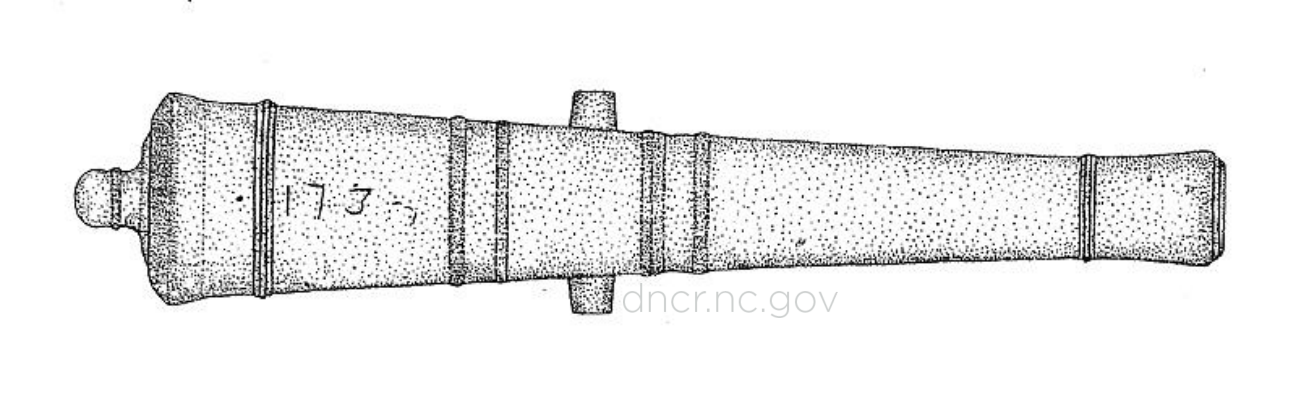
DESCRIPTION: Cannon 3 (QAR 233.001) is a cast iron gun, approximately 7-feet in length (base ring to muzzle) that is a bit of an anomaly among the recovered artillery from the site. (1)With each of the other four guns, the reinforces run nearly parallel to the bore with distinct step-downs at the junctures of the 1st to 2nd reinforce and the 2nd reinforce to the chase. This gun has no distinct step-downs at the reinforce junctures, the sides instead forming a nearly straight line from the vent field to the muzzle astragal. The reinforces are delineated only by the reinforce rings. (2)Also unique is the presence of second rings just muzzleward of the 1st and 2nd reinforce rings. (3)Finally, this guns has a button astragal that is absent on the other four guns.
The trunnions are slightly conical in shape with no markings on the faces. In fact, the only marks on the piece are a set of crudely formed numerals chiseled into the top of the first reinforce. These numerals: 1,7,3, and possibly a 0 have been interpreted as indicating the gun’s weight, in hundredweights. This interpretation is supported by the fact that when calculated to pounds [17(112) + 3(28) + 0 = 1988 lbs) the marked weight only exceeds the present weight of the gun by 3.5%. This difference can be attributed to the loss of surface iron through corrosion.
The gun was in a loaded condition when recovered with powder cartridge (disintegrated), inner wad, a 6-pounder ball (theoretical weight), and an outer wad. The measured bore diameter of 4.08 inches is more of the size computed for an English 8-pounder or a French 7-pounder. 1 This discrepancy is possibly attributable to loss of metal in the bore through corrosion and an aggressive cleaning and disarming process in the conservation laboratory. Regardless of the theoretical caliber, it was being used as a 6-pounder. No tampion was in the muzzle, therefore the bore was thoroughly fouled with concretion when the gun was recovered.
ARCHAEOLOGICAL CONTEXT:
The gun was recovered from an area immediately to the southwest of the ballast pile within a subgroup of 4 guns that included Cannon 1, Cannon 2 (recovered, see 232.001), and Cannon 14. Though adjacent to numerous ferrous concretions, primarily iron cask hoops, the only artifacts physically attached to the gun were two iron shot: one 3.3-inches diameter and a bar shot 3.4 inches diameter. No confirmed gun-carriage parts were recovered adjacent to the gun.
1 John Muller (1780) A Treatise of Artillery 3rd ed. Reprint 1965 Musem Restoration Service, Ottawa, Ontario: 6,10.
1
John Muller (1780) A Treatise of Artillery 3rd ed. Reprint 1965 Musem Restoration Service, Ottawa, Ontario: 6,10.